Case study 01 · AI adoption
Towing the Fleet Forward
A framework for adopting AI when nobody can tell you what the technology will look like in eighteen months — built as a deck, a short film and a worksheet, then delivered live to a room of people who had every reason to be skeptical.
Watch it first
The teaser. Thirty-five seconds, sent out ahead of the session to get people in the room.
The elevator cut. 2016 versus 2026, under a minute. Built for the people who would never open an 18-slide deck.
The problem
Every organisation trying to adopt AI runs into the same trap, and it is a symmetric one. Move now and you build on a technology that will be obsolete before the training finishes. Wait for the dust to settle and you spend the waiting period getting further behind. Both instincts are rational. Both are wrong. There is no correct moment to depart, because the thing you are waiting for — a stable, finished version of AI — does not exist and is not coming.
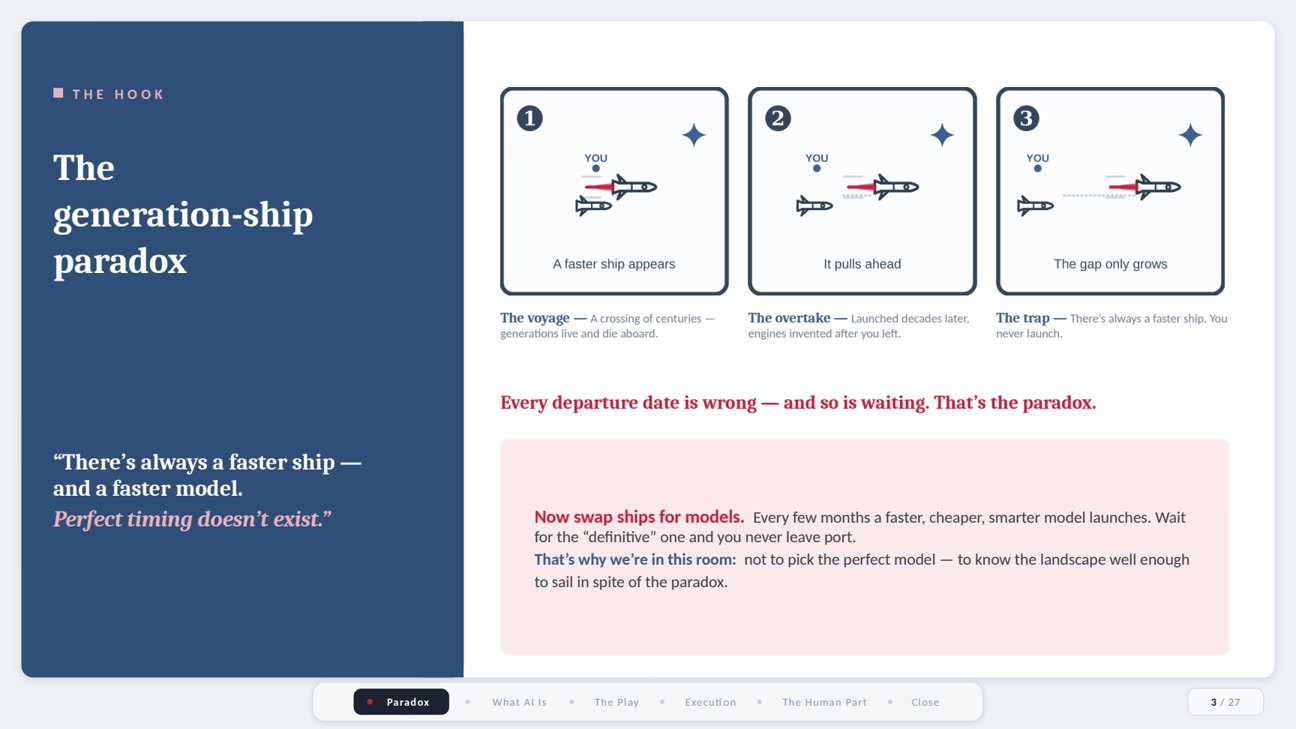
A generation ship launches for a star a thousand years away. Two hundred years in, it is passed by a faster ship that left a century later. The generation-ship paradox — slide 3
That is the paradox the deck opens on, and it is the honest framing of the problem. If you had waited, you would have launched later on a better ship. If you had gone, you would already be halfway. Perfect timing is not available. What you actually get to choose is whether the thing you have already built comes with you.
The approach
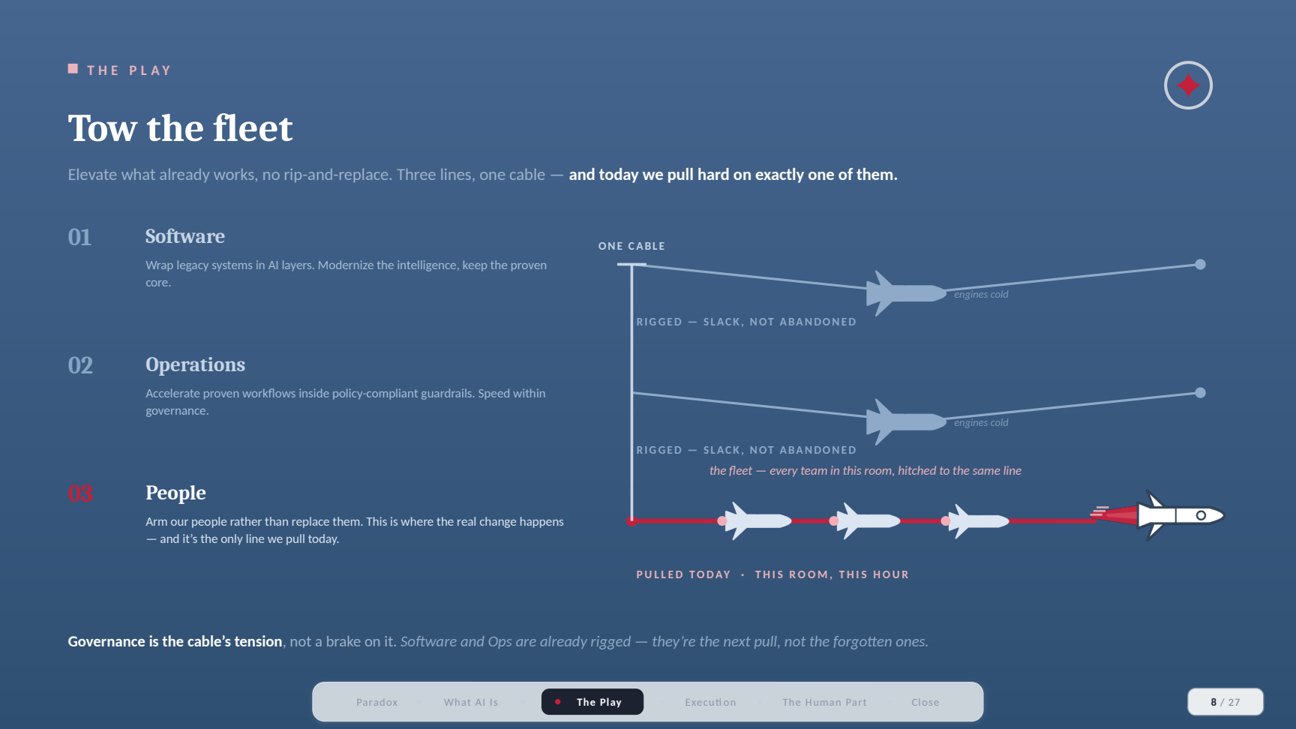
The answer in the deck is towing: you do not wait for the perfect ship and you do not abandon the one you are on. You attach what you have to what is coming and you keep moving. It is a framework defined by the uncertainty rather than in spite of it.
A trigger, not a date
The single most useful thing in the deck is that it replaces the roadmap question with a condition. You do not adopt on a calendar. You adopt the moment value now exceeds the friction of switching later. That inverts the whole debate — instead of arguing about when the technology will be ready, you argue about a number you can actually observe this quarter.
Three places the tow line attaches
Wrap the legacy systems in AI layers rather than replacing them. The rewrite you keep deferring is not the prerequisite you think it is.
Accelerate inside the guardrails you already have. Measurable pilots, not a transformation programme.
The biggest upside and the part everyone under-invests in. Recent grads bring the how; established leaders bring the what and the why.
Recent grads tow established leaders. Established leaders tow recent grads. Nobody gets cut. Slide 5
That line does more work than anything else in the deck. The reflex in a downturn is to thin the junior bench, and it is precisely backwards: the people who already think in these tools are the ones who can teach the mechanics, while the people with twenty years of judgment are the ones who know which problems are worth pointing them at. Neither half is sufficient. The transfer has to run in both directions or you get fluent nonsense from one end and well-reasoned paralysis from the other.
Governance is the enabler, not the brake
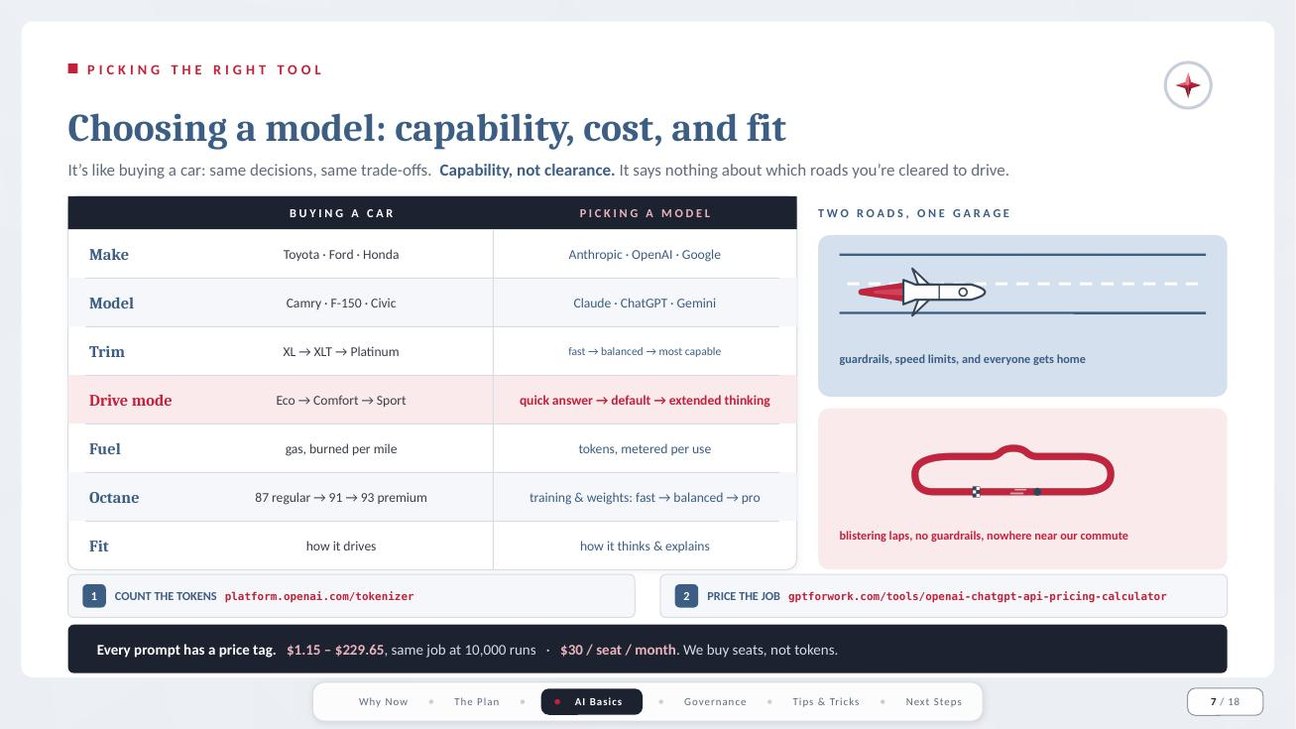
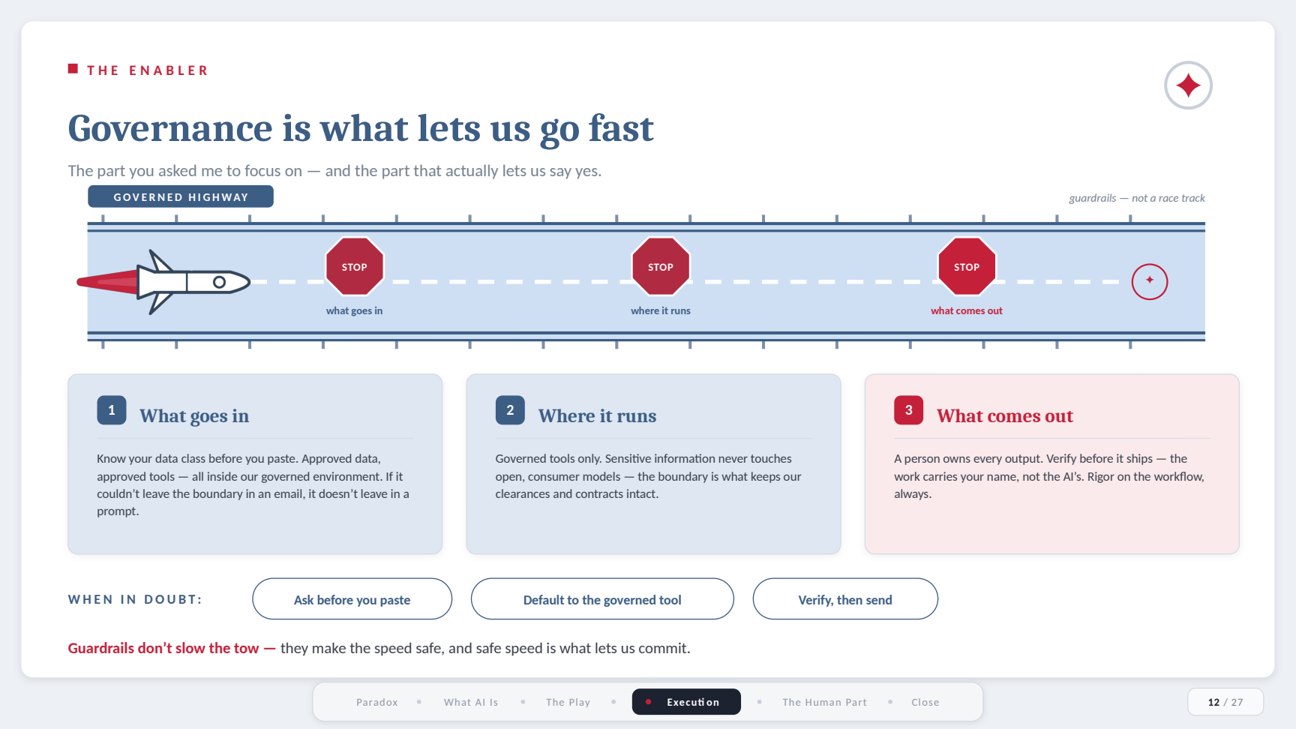
The other reframe the deck insists on. Approved tools, clear data classifications, data that stays home, and a human who verifies — these are not the tax you pay for moving. They are the reason you are allowed to move at all. A team with clear rules ships faster than a team quietly hoping nobody notices what they pasted into a chat window.
The honest part
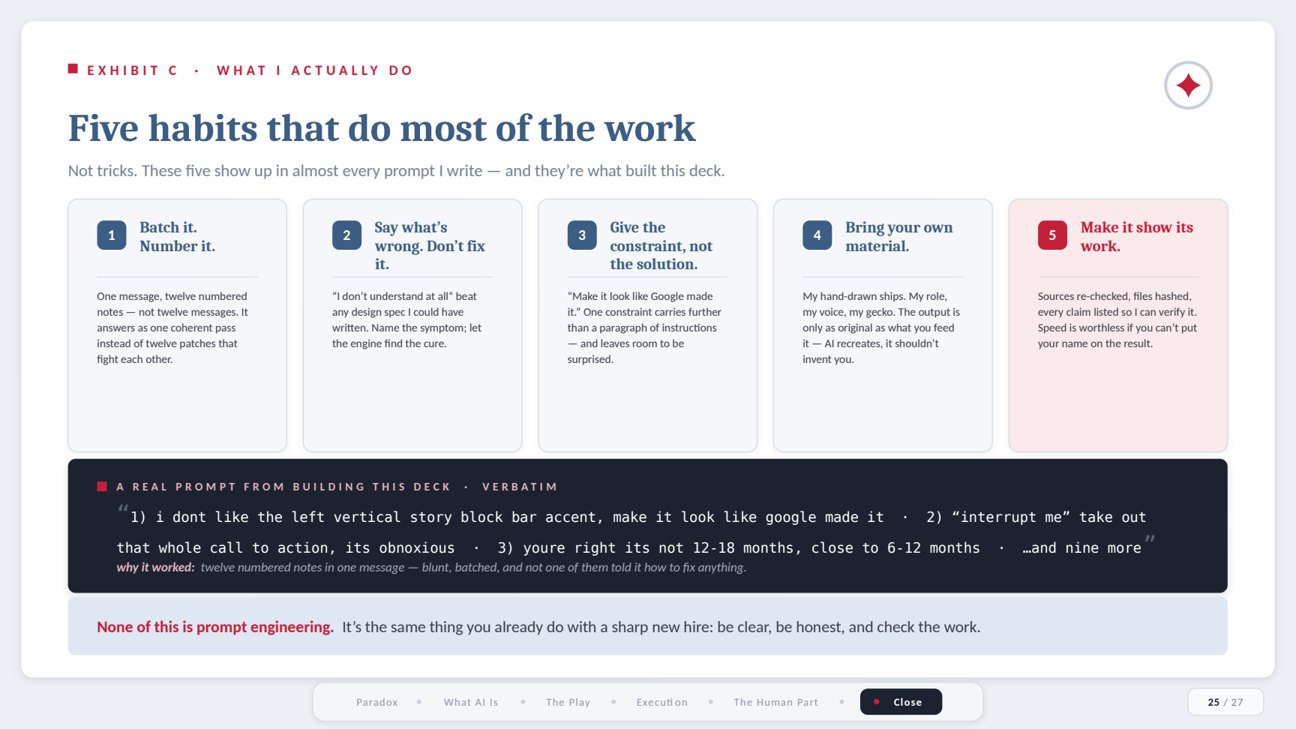
The deck does not pretend the output is free. Slop is real, the quality trap is real, and a draft that arrives in four seconds still needs someone who can tell whether it is any good. That is why the close is not a technology claim.
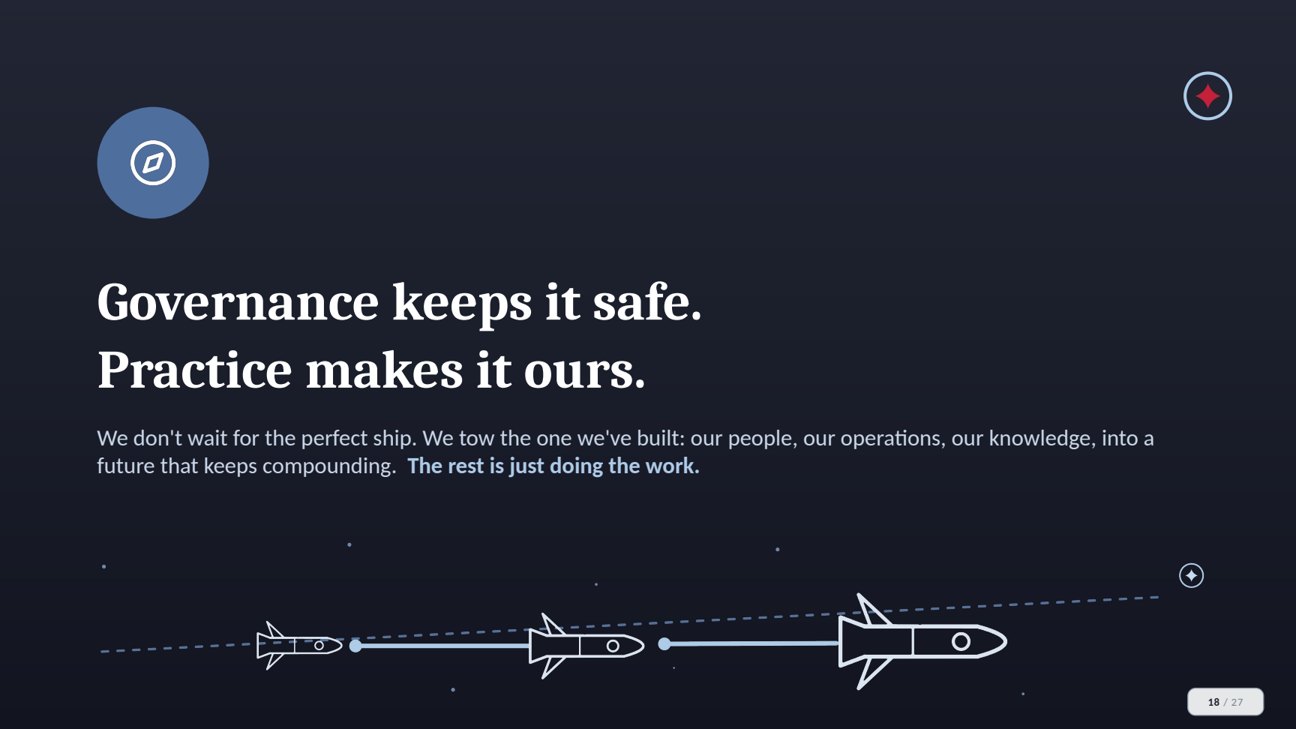
Governance keeps it safe. Practice makes it ours. We don't wait for the perfect ship — we tow the one we've built. The close
The artifacts
A talk that ends when the room empties has not adopted anything. So the deck shipped with a kit around it: something to watch before, something to fill in during, and something to hand your own team after.
The deck built itself
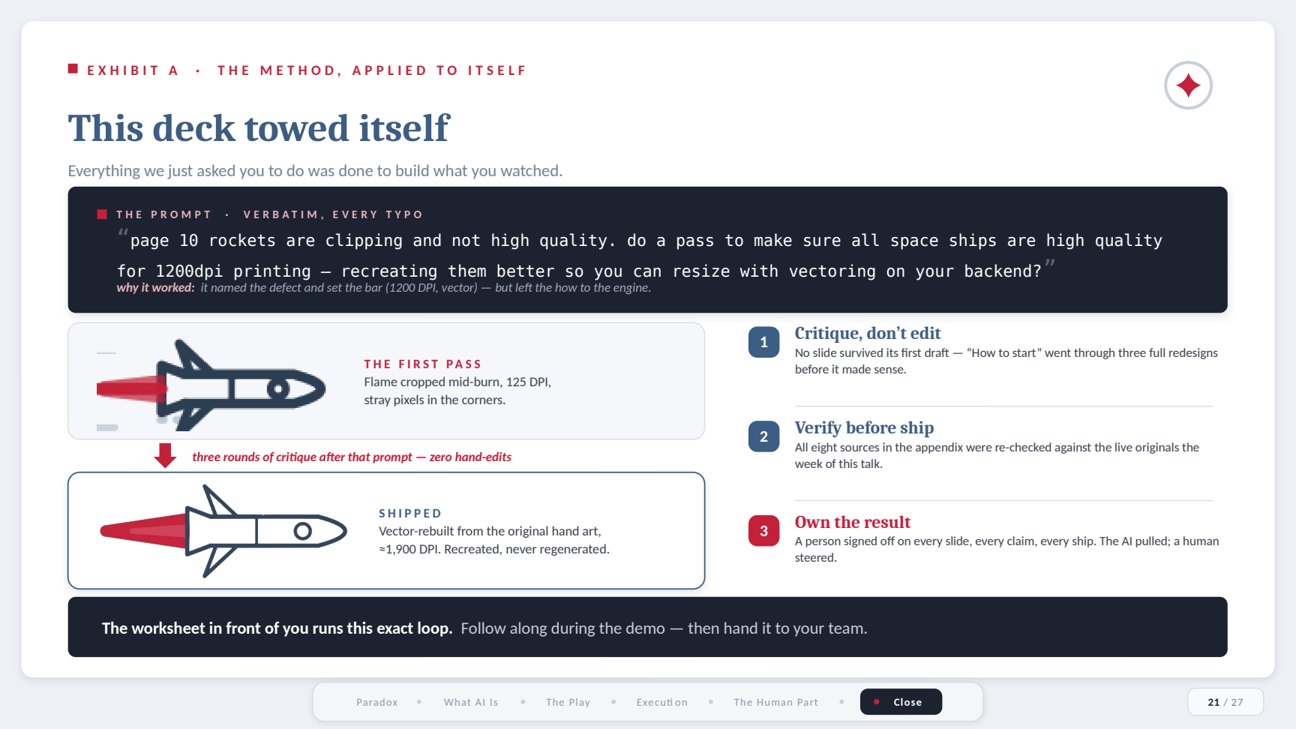
One slide near the end breaks the fourth wall: the deck itself was drafted, structured and illustrated using exactly the workflow it recommends. It is the only proof in the room that does not require anyone to take my word for it.
Downloads
Everything in the kit, as shipped. The worksheet is the one that actually gets used after the session.