Case study 03 · Framework & team project
HumAIne
Every organization adopting AI is asking how fast it can go. Almost none are asking what happens to the people on the way. HumAIne is Group 11’s answer to that second question — a framework built over the MIT Professional Certificate Program in Digital Transformation in the AI Age, arguing that AI adoption should be measured by whether it expands what people can do, not by how many people it removes.
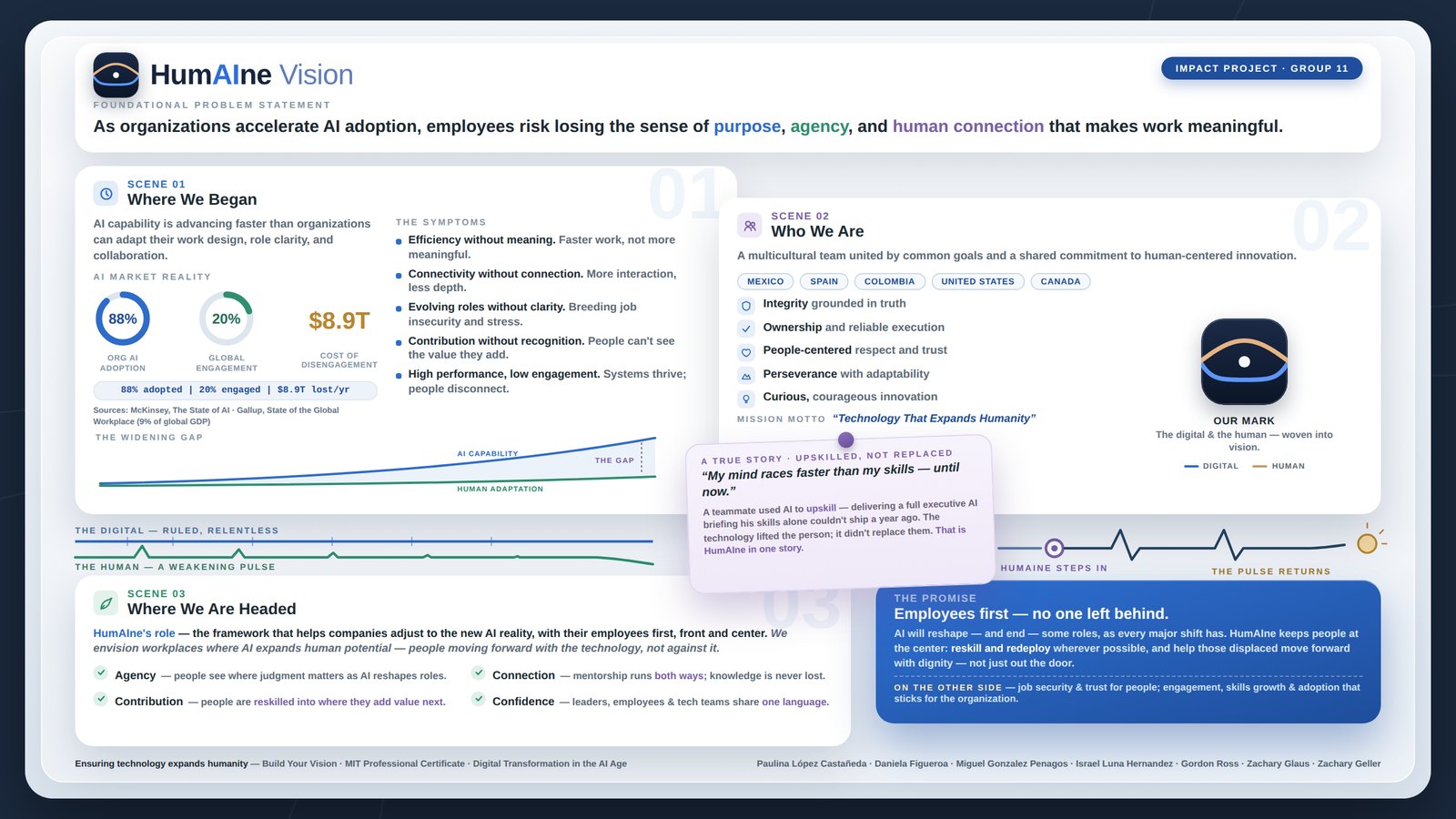
Paulina López Castañeda · Zachary Geller · Daniela Figueroa · Miguel Gonzalez Penagos · Israel Luna Hernandez · Gordon Ross · Zachary Glaus
The problem
As organizations accelerate AI adoption, employees risk losing the sense of purpose, agency, and human connection that makes work meaningful. HumAIne · foundational problem statement
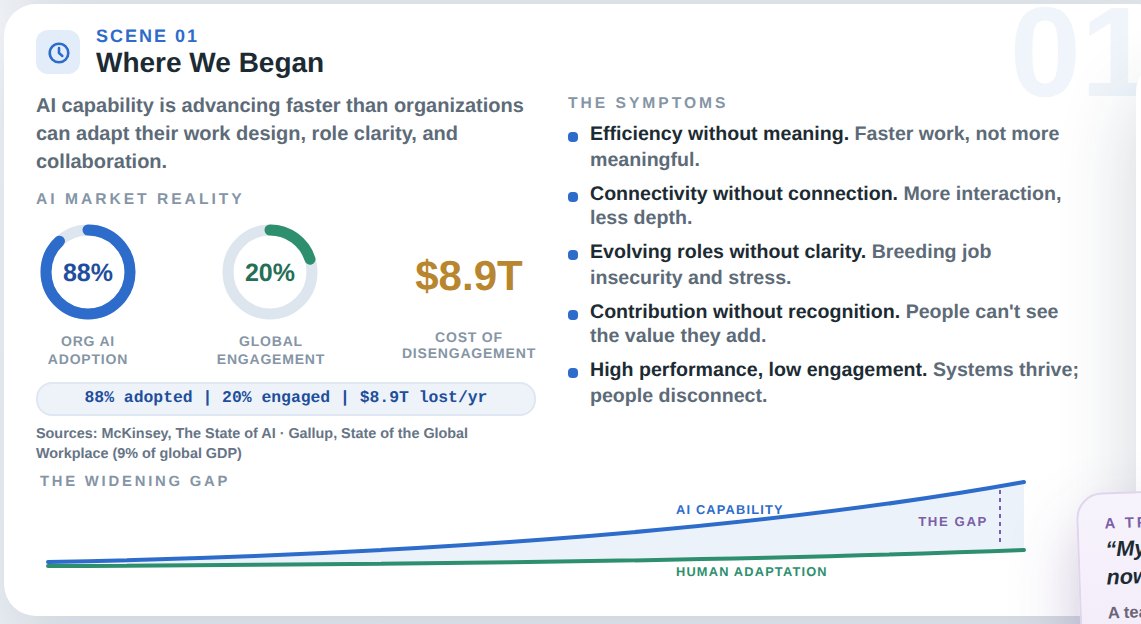
It rarely arrives as a crisis. It looks like work getting faster while feeling emptier. The team found the same five symptoms in every organization moving quickly, and they are the spine of the whole framework.
Work gets faster. It does not get more meaningful.
More interaction, less depth.
The shift from doing to thinking is never explained, and people are left unsure where they still fit.
People can no longer see how their work creates value.
The systems run perfectly while the humans quietly disconnect.
Underneath all five sits the thing organizations rarely name out loud: job insecurity. The market’s reflex is to cut entry-level roles because AI now does the foundational work, and employees feel that. The result is a workforce that is measurably more productive and quietly more afraid — and fear is not the ground you build a transformation on.
Sources: McKinsey, The State of AI; Gallup, State of the Global Workplace. Digital capability is racing ahead; the human side of work is not keeping up.
None of this is an argument against AI. It is an argument for adopting it more thoughtfully.
The approach
HumAIne connects AI adoption to five layers, so human outcomes are designed in at the start rather than hoped for at the end. Read top to bottom it is a chain of accountability: if you cannot say why you are adopting, you cannot design the work, and if you cannot design the work the outcomes never arrive.
The four outcomes
People understand how AI changes their role and where their judgment still matters. Newer, AI-fluent employees bring the how; experienced people bring the what and why. Nobody becomes a button-pusher and nobody’s experience becomes obsolete.
Mentorship that runs both ways. A junior can pull a senior forward into new capability; a senior can pull colleagues along with hard-won judgment. The working relationships are what make a team stronger than its tools.
Where the framework draws its hardest line. When the market’s instinct is to cut the people whose foundational work AI can now do, the human-centered move is the opposite: arm them, don’t cut them.
Leaders, employees and technology teams share one common language for adoption. Closing that gap is a leadership responsibility, not a generational excuse.
Governance is the enabler, not the brake
It is easy to hear “governance” as the thing that slows adoption down. The team argued the opposite. Approved tools, clear data boundaries and a human verifying every output are exactly what let an organization move quickly and keep people’s trust. The image the team kept coming back to is the tension in a tow cable: it is not drag on the speed, it is what keeps everything connected as you accelerate.
Why now, and not once it is mature
If models are only going to get cheaper and more capable, why not wait for the finished version? Because the model was never the advantage. The advantage is the context and fluency an organization’s people build by doing the work — the data, the workflows, the shared judgment — and that compounds. None of it arrives in a box later. The cost of starting is a sliver of time now; the return runs across an open-ended horizon. The expensive choice is waiting.
My mind races faster than my skills — until now. A teammate, on the month he spent building and delivering a full executive AI briefing
That is the framework in one story. A domain expert whose ideas had always outrun his ability to ship them used AI to close the gap. The technology did not replace his judgment; it expanded what one person could contribute, while the human stayed in the driver’s seat verifying every output. Multiply that across a workforce, deliberately and under governance, and you have the future the project is arguing for.
The promise the team put its name to. Employees first — no one left behind. AI will reshape, and end, some roles, as every major shift has. HumAIne keeps people at the center: reskill and redeploy wherever possible, and help those displaced move forward with dignity — not just out the door.
The artifacts
The project’s output is a single dense one-pager that has to carry the whole argument — problem, team, framework and promise — in one view, plus the identity built around it.
Scene 01 — where we began
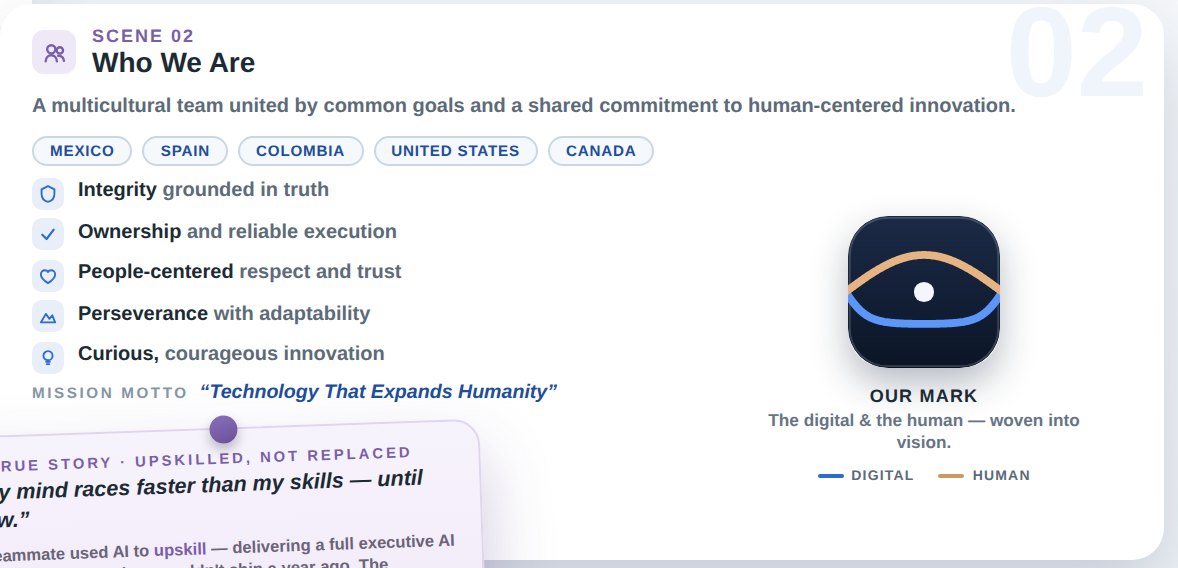
Scene 02 — who we are
Scene 03 — where we are headed

The pulse
The narrative device running across the middle of the page is a single line: the digital signal, ruled and relentless, above a human pulse that weakens as the page moves left to right — until HumAIne steps in and the pulse returns. It is the argument compressed into one graphic.

The mark
Two strands — one digital, one human — crossing at a single white node. Neither strand ends and neither wins; they meet. It is the only piece of the identity that has to work at sixteen pixels, so it had to be one idea.

The mark in motion
The two strands drawing themselves in and meeting. Roughly ten seconds.
Downloads
The one-pager is the deliverable. The narrative is the long-form version of the same argument, for anyone who wants the reasoning rather than the summary.